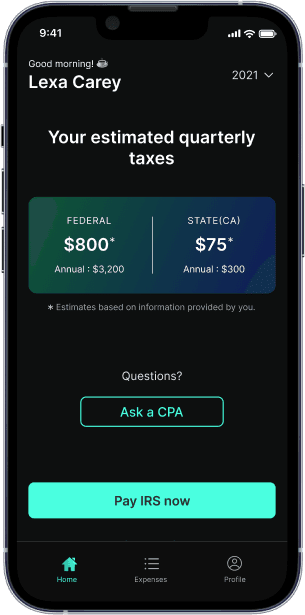
Quarterly tax deadline is Jan 15. See how much you owe penalties
1099 Tax Calculator

Are you self-employed?
This includes freelancers and business owners.
Leasehold Improvements Section 179: Impact on Vehicle Lease vs. Purchase Deduction
As a self-employed individual, managing your business expenses effectively is crucial for maintaining a healthy financial situation. One of the most significant decisions you'll face is whether to lease or purchase a vehicle for your business. This choice not only affects your operational efficiency but also has significant implications for your tax obligations. In this article, we'll delve into the impact of leasing versus purchasing on Section 179 deductions, a crucial tax benefit for businesses. To understand if your vehicle qualifies, check outthis guide on vehicle qualification for Section 179 deduction.
Table of contents
Understanding Section 179 Deduction
The Section 179 deduction is a powerful tax incentive designed to encourage businesses to invest in themselves by purchasing qualifying equipment and software. Under this provision, businesses can deduct the full purchase price of qualifying tangible personal property and equipment that is placed in service during the tax year. This immediate expensing can significantly reduce taxable income, providing substantial tax savings.
For example, if a business purchases a piece of equipment for $50,000 and it qualifies for the Section 179 deduction, the entire $50,000 can be deducted from the business’s taxable income in the year the equipment is placed in service. Additionally, qualified improvement property for nonresidential real property also qualifies for Section 179 deductions. This is a stark contrast to traditional depreciation methods, which spread the cost recovery over several years. By allowing businesses to deduct the full cost upfront, Section 179 helps improve cash flow and incentivizes further investment in business property.
Can Leased Vehicles Qualify as Section 179 Qualifying Property?
The first question many business owners ask is whether leased vehicles can qualify for Section 179 deductions. The answer is straightforward: no, leased vehicles do not qualify for Section 179 deductions. This section of the tax code allows businesses to deduct the full purchase price of qualifying business assets in the first year, but it specifically excludes leased vehicles.
Pros and Cons of Leasing vs. Purchasing for Section 179 Eligibility
Leasing
- Immediate Deductions: Leasing allows you to deduct the lease payments as a business expense, which can provide immediate tax savings. However, this deduction is limited to the business-use percentage of the vehicle.
- Flexibility: Leasing often comes with lower monthly payments compared to purchasing a vehicle outright.
- No Depreciation: Since you don't own the vehicle, you don't have to worry about depreciation deductions, which can be complex and time-consuming.
Purchasing
How Lease Payments May Qualify as Business Expenses
When you lease a vehicle for business use, you can deduct the lease payments based on the percentage of business use. For example, if you use the vehicle 70% for business and 30% for personal use, you can only deduct 70% of the lease payments as a business expense.
Calculating Business-Use Percentage
Long-Term Tax Benefits of Purchasing a Vehicle Placed in Service Under Section 179
While leasing offers immediate tax deductions, purchasing a vehicle under Section 179 provides long-term tax benefits. Here’s how it works:
- Section 179 Deduction: You can deduct the full purchase price of the vehicle in the first year, up to a certain limit. For 2024, the maximum deduction is $19,800 for cars and $27,000 for SUVs. Additionally, qualified leasehold improvement property and qualified restaurant property also qualify for Section 179 deductions, allowing businesses to deduct the cost of improvements in the first year.
- Depreciation: After the initial Section 179 deduction, you can claim depreciation deductions over the recovery period of the vehicle. This spreads out the cost over several years, providing additional tax savings.
Deducting Lease Payments vs. Vehicle Purchase
Lease Payments
- Deductible Amount: The deductible amount for lease payments is based on the business-use percentage of the vehicle. This means you only deduct the portion of the lease payment that corresponds to business use.
- Record Keeping: You need to keep detailed records of your lease payments and business use to accurately calculate the deductible amount.
Vehicle Purchase
- Section 179 Deduction: You can deduct the full purchase price of the vehicle in the first year, up to the specified limits. Additionally, qualified retail improvement property (QRIP) also qualifies for Section 179 deductions, allowing for significant tax savings on improvements made to the interior of nonresidential buildings.
- Depreciation: You can claim depreciation deductions over the life of the vehicle, which can provide additional tax savings.
How Leasing Impacts Vehicle Bonus Depreciation Deductions
Leasing a vehicle does not allow you to claim depreciation deductions. Since you don’t own the vehicle, you don’t have to worry about its depreciation. However, this means you miss out on the potential long-term tax savings that come with depreciating an asset over time.
IRS Rules for Leased Vehicle Business Use
The IRS has specific rules regarding the business use of leased vehicles. Here are some key points to consider:
- Business-Use Percentage: You must determine the business-use percentage of the vehicle to accurately calculate your deductions.
- Lease Inclusion Amount: If the vehicle’s fair market value exceeds a certain threshold, you may need to include a portion of the lease payments in your gross income. For 2024, this threshold is $56,000 for cars with a GVW of 6,000 pounds or less.
Conclusion
Choosing between leasing and purchasing a vehicle for your business is a complex decision that involves considering both short-term and long-term tax implications. While leasing offers immediate tax deductions and flexibility, it excludes you from the Section 179 deduction and depreciation benefits. Purchasing a vehicle, on the other hand, provides the opportunity to take advantage of the Section 179 deduction and claim depreciation over time, but it requires a larger upfront investment.
Ultimately, the decision should be based on your specific business needs and financial situation. It is advisable to consult with a tax professional to ensure you are making the most tax-efficient choice for your business. By understanding the impact of leasing versus purchasing on Section 179 deductions, you can make an informed decision that maximizes your tax savings and supports your business growth. For more insights, consider why you shouldmake estimated tax payments.
Additional Tips for Self-Employed Individuals Under the Tax Cuts and Jobs Act
- Keep Detailed Records: Accurate record keeping is crucial for calculating your business-use percentage and ensuring you take the correct deductions.
- Consult a Tax Professional: Tax laws are complex and subject to change. A tax professional can help you navigate the intricacies of Section 179 deductions and ensure you are taking advantage of all available tax benefits.
- Review Lease Agreements: Carefully review your lease agreements to understand any potential penalties or restrictions on business use. If you’re reporting self-employment income without a 1099,here’s how to do it.
- Be Aware of Changes in Bonus Depreciation: Be aware of changes in bonus depreciation for tax years beginning after December 31, 2022, as these changes can affect the eligibility and amount of deductions available for certain properties and improvements.
- Understand the Alternative Depreciation System: The alternative depreciation system (ADS) may apply to certain properties, affecting the recovery period calculation. This is particularly relevant for qualified improvement property and can impact Section 179 deductions.
- Tax Benefits for Interior Portion Improvements: Improvements to the interior portion of nonresidential buildings can qualify for immediate expensing under the Tax Cuts and Jobs Act, provided they do not involve structural components or enlargements.
- Internal Structural Framework Exclusions: Improvements to a building's internal structural framework do not qualify for favorable tax treatment under Section 179, impacting the categorization of leasehold improvements.
- Include Security Systems for Depreciation: Security systems can be included for depreciation under Section 179, making them a valuable consideration for businesses looking to maximize their tax deductions.
By following these guidelines and understanding the impact of leasing versus purchasing on Section 179 deductions, you can make informed decisions that support your business’s financial health and maximize your tax savings. For more information on car tax write-offs, visitthis resource.
What’s FlyFin?


Expert tax CPAs ensure 100%-accurate tax filing

A.I. finds every tax deduction, eliminating 95% of your work

On average users save $3,700