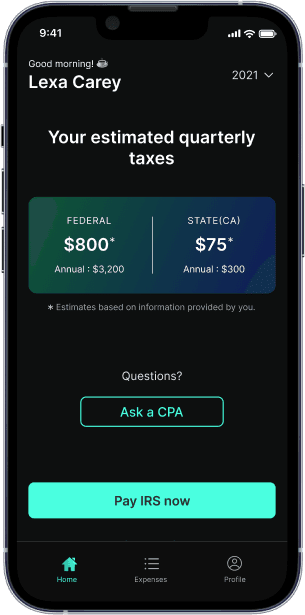
1099 Tax Calculator

Are you self-employed?
This includes freelancers and business owners.
Calculating PA Self Employment Tax
The intricacies of self-employment taxes are probably nothing new to Pennsylvanians who work for themselves. But don’t fear, once you learn the fundamentals of employment tax for Pennsylvania, it might be easy to understand these taxes. Social Security and Medicare taxes are combined to form Pennsylvania’s self-employment tax, which is 15.3% of your net self-employment income [1].
Table of contents
What is Self Employment Tax?
Self-employment tax is a type of employment tax specifically for individuals who work for themselves, such as sole proprietors, freelancers, and independent contractors. This tax is crucial as it funds Social Security and Medicare benefits for self-employed individuals. Essentially, self-employment tax is calculated as a percentage of your net earnings from self-employment, which includes income from businesses, professions, and farms. The tax rate stands at 15.3%, broken down into 12.4% for Social Security and 2.9% for Medicare. Understanding this tax rate is essential for all self-employed individuals to ensure they are contributing appropriately to their future benefits.
Who Must Pay Employment Tax?
Employment tax, including self-employment tax, is mandatory for individuals who earn income from self-employment. This encompasses a wide range of professionals, including:
- Sole proprietors
- Freelancers
- Independent contractors
- Business owners
- Self-employed individuals who earn $400 or more in net earnings from self-employment
Additionally, employers with employees are required to pay payroll taxes on their behalf. It’s important for all self-employed individuals to recognize their obligation to pay self-employment tax to stay compliant with tax laws.
Estimated Quarterly Tax Payment Calculation
Your self-employment tax calculation is quite easy. The first thing you do is figure out how much money you make working for yourself as a sole proprietor. This is the total amount of money you make from your firm less any deductible business expenses. You apply the self-employment tax rate of 15.3% after you have your net profits. The tax rates are broken down as follows: In 2024, the Social Security tax is 12.4% of your net income, with a maximum of $137,700. The Medicare tax is 2.9% of your total income.
For instance, you would compute your self-employment tax using the following formula if your business brought in $100,000 in net earnings: The total self-employment tax is $12,400 + $2,900 = $15,300. The social security tax is $100,000 x 0.124 = $12,400. The Medicare tax is $100,000 x 0.029 = $2,900. Four times a year, on April 15th, June 15th, September 15th, and January 15th of the subsequent year, you are required to submit estimated tax payments. Penalties may apply if these payments are not made on time. For more details on important dates, check theIRS quarterly payment dates for 2024.
Self-Employed Individuals' Business Expense Deductions
Monitoring and optimizing your company cost deductions is one of the best strategies to lower your self-employment tax burden. By drastically lowering your taxable income, these deductions can help you pay less in self-employment taxes. The following are some typical deductions for business expenses:
- Home Office Deduction:You may deduct a portion of your rent or mortgage interest and utilities if you utilize a specific area of your house for work.
- Equipment and Supplies:You can deduct any supplies or equipment you buy for your company.
- Travel Expenses:Travel expenses for business purposes, such as housing and transportation, are deductible.
- Professional Fees:Professional fees can be deducted if they are paid to accountants, attorneys, or other professionals for services linked to the business.
- Medical Savings Account Contributions:Contributions to a Medical Savings Account (MSA) can be deducted from your state taxable income.
For example, before determining your self-employment tax, you can deduct $5,000 from your net earnings if you spend it on supplies and equipment for your firm. To learn more about eligible deductions, visitdeductions for the self-employed.
Merging Pennsylvania and Federal Self-Employment Taxes
In Pennsylvania, you must take into account both federal and state self-employment taxes if you work for yourself. This is how it operates:
- Federal Self-Employment Tax:The same rates that were previously discussed are used to determine your federal self-employment tax (12.4% for Social Security and 2.9% for Medicare). You use Schedule SE on your federal tax return to report this tax.
- Pennsylvania Self-Employment Tax:You must pay self-employment tax in Pennsylvania at the same rates (12.4% for Social Security and 2.9% for Medicare). Schedule SE is used to determine the tax owed, while Form 1040-ES is used to record anticipated tax payments.
- Combining Both:You must make sure that no deductions are being double-counted when combining both federal and state self-employment taxes. To prevent double taxation, you should, for instance, claim any federal deductions you are entitled for on your Pennsylvania return. When calculating your federal self-employment tax, you can deduct a portion of your self-employment tax to determine your adjusted gross income, which impacts your overall income tax but not your net earnings.
Self-Employment Tax Deductions by State
Certain deductions are permitted in Pennsylvania, which may lower your state self-employment tax obligation. Key deductions include the following:
- Medical Savings Account (MSA) Contributions:In the event that you have a Medical Savings Account (MSA), you can deduct your contributions from your state taxable income.
- Health Savings Account Contributions:Health Savings Account (HSA) contributions are deductible as well.
- IRC Section 529 Qualified Tuition Program Contributions:Under Section 529 of the IRS code, contributions to qualified tuition programs are deductible up to the Federal gift tax exclusion per beneficiary each year.
These deductions can significantly reduce your overall income taxes, making it easier to manage your tax liabilities.
For instance, you can deduct $3,000 from your net income before determining your state self-employment tax if you make a $3,000 contribution to an MSA. To assist with your calculations, consider using aPennsylvania state income tax calculator.
Calculating Self-Employment Income using State Tax Calculators
You can estimate your self-employment tax requirements more precisely by using a state tax calculator. These calculators make sure you don’t overpay your taxes or miss any deductions by accounting for both federal and state tax rates. To utilize a state tax calculator, follow these steps:
- Input Your Net Earnings:Enter the whole amount of money you make working for yourself.
- Select Your Business Expenses:To determine how your business expenses affect your taxable income, make a list of all of your expenses.
- Calculate Your Tax:Using the rates and deductions you have input, the calculator will give you an approximate amount of self-employment tax.
Accurate calculations can help you avoid overpaying and ensure that your tax bill is as low as possible.
You can minimize your tax liability and make sure you’re making proper quarterly payments by using these calculators. For more information on filing taxes as a self-employed individual, visitfiling taxes for the self-employed.
Common Mistakes to Avoid
When dealing with self-employment tax, several common mistakes can lead to complications and increased tax liability. Here are some pitfalls to watch out for:
- Not reporting self-employment income:Failing to report all self-employment income can result in penalties and interest.
- Not paying self-employment tax:Self-employed individuals must pay self-employment tax on their net earnings from self-employment.
- Not keeping accurate records:Accurate records are essential for calculating self-employment tax and supporting deductions and credits.
- Not taking advantage of deductions and credits:There are various deductions and credits available to self-employed individuals that can reduce their tax liability.
- Not making estimated tax payments:To avoid penalties and interest, self-employed individuals must make estimated tax payments throughout the year.
By steering clear of these common mistakes, self-employed individuals can ensure compliance with employment tax laws and regulations while minimizing their tax liability.
Final Thoughts
Pennsylvania self-employment tax estimation can be intimidating, but it’s doable if you know the fundamentals. You can drastically lower your tax burden by documenting business spending, calculating your quarterly payments, and combining your federal and state tax responsibilities. To guarantee accuracy and compliance, don’t forget to utilize state-specific deductions and tax calculators. You can confidently negotiate the world of self-employment taxes if you have the appropriate resources and information.
Proper preparation and documentation can make tax time much less stressful for self-employed individuals.
The purpose of this book is to provide you a thorough grasp of Pennsylvania self-employment tax estimation. Knowing these taxes is essential for preserving compliance and financial security, regardless of whether you work as an independent contractor or freelancer. You’ll be ready to manage the intricacies of self-employment taxes and concentrate on expanding your company if you follow the instructions in this tutorial.
What’s FlyFin?


Expert tax CPAs ensure 100%-accurate tax filing

A.I. finds every tax deduction, eliminating 95% of your work

On average users save $3,700