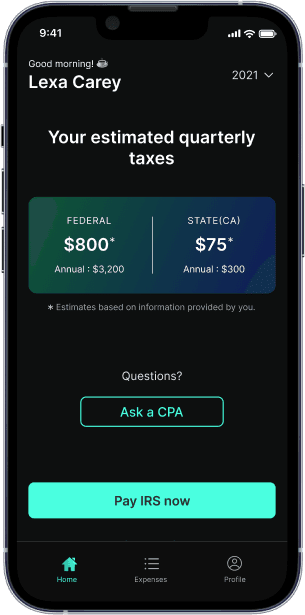
Quarterly tax deadline is Jan 15. See how much you owe penalties
1099 Tax Calculator

Are you self-employed?
This includes freelancers and business owners.
Tax Credits You Can Use This Year for Self-Employment: Subtracting Computers, Business Tools, and Office Supplies
Managing your money and taxes as a 1099 earner can be very difficult. Taking deductions for the materials and equipment you use for your business is one of the best strategies to lower your self-employment taxes. We will examine the different write-offs for computers, office supplies, business tools, and other necessary equipment in this post. Knowing these deductions can help you save money and keep more of your hard-earned money, whether you are an independent contractor, freelancer, or business owner. For a more detailed understanding, you can use the1099 tax calculatorto estimate your potential savings. Business insurance premiums can also be deducted as a business expense.
Table of contents
You can deduct these business expenses in the following ways:
Office Supplies
Everything you need to run your business is included in office supplies. Basic stationery like pens, paper, and sticky notes can be included, as well as more specialist supplies like binders and paper clips. Smaller expenses, such as client greeting cards, may qualify for a deduction. The secret is to monitor these costs all year long. Only the supplies you used up throughout the year—not those you kept on hand for later use—can be claimed as costs. You can learn more aboutoffice expense deductionsto maximize your savings.
Printers and Computers
Tools for Business and Home Office Deduction
Types of Business Expenses
As a self-employed individual, understanding the different types of business expenses that can be deducted from your taxable income is crucial. Business expenses are costs incurred while operating your business, and they can be categorized into various types. Here are some common types of business expenses:
- Operating Expenses: These are the costs associated with running your business, such as rent, utilities, and employee salaries. For instance, if you rent an office space or pay for electricity to keep your business running, these costs fall under operating expenses.
- Capital Expenses: These are the costs associated with acquiring or improving assets, such as equipment, property, or vehicles. For example, purchasing a new computer for your business or renovating your office space would be considered capital expenses.
- Travel Expenses: These are the costs associated with traveling for business, such as transportation, lodging, and meals. If you travel to meet clients or attend conferences, the expenses incurred during these trips can be deducted.
- Entertainment Expenses: These are the costs associated with entertaining clients or customers, such as meals, tickets, or events. Taking a client out for dinner or hosting a business event can be categorized as entertainment expenses.
- Education Expenses: These are the costs associated with improving your skills or knowledge, such as courses, workshops, or conferences. Investing in a workshop to enhance your professional skills or attending a conference relevant to your industry are deductible education expenses.
Understanding Different Business Expenses
Recording Business Expenses
Depreciation of Equipment vs Purchase Year Expenses
Depreciation or expensing in the year of purchase are the two primary options when it comes to equipment such as computers, printers, or specialist tools. Depreciation affects your net earnings, which is crucial for calculating your self-employment tax. Understanding depreciation can help in calculating the self employment tax deduction.
Depreciation
Costing in the Purchase Year
Terminating Business Services, Apps, and Software Subscriptions
Apps and software subscriptions are crucial for many firms in the current digital era. You can deduct these costs in the following ways:
Subscriptions for Software
Applications
Services for Businesses
Creative Professional Deductions: Lighting, Microphones, and Cameras
Photographers, videographers, and audio engineers are examples of creative occupations who frequently need specialized equipment. You can deduct these costs in the following ways:
Photography Equipment and Cameras
Audio Equipment and Microphones
Illumination
Home Office Deduction
The home office deduction is a valuable tax deduction for self-employed individuals who work from home. Here’s what you need to know:
Home Office Deduction Basics
Business Equipment Depreciation Over Time
Computers, printers, and specialized tools are examples of business equipment that loses value over time. You can depreciate these assets in the following ways: Understanding equipment depreciation can also impact your qualified business income deduction.
Equipment depreciation affects the calculation of self employment tax by reducing the taxable income, which in turn lowers the amount of Social Security and Medicare taxes paid by independent contractors or freelancers.
Section 179 Deductions and Qualified Business Income Deduction for Purchases of Equipment
Gradual Depreciation
Final Thoughts on Self Employment Tax
Paying close attention to details is essential while managing your money as a 1099 earner, particularly when it comes to tax deductions. Understanding income tax and its implications for self-employed individuals is crucial. Understanding the different write-offs for computers, office supplies, business tools, and other necessary equipment can help you lower your self-employment taxes considerably. Additionally, as a self-employed individual, you are obligated to pay both the employer's and employee's portions of Medicare taxes. Don’t forget to compute business-use percentages for products used both personally and professionally, and keep thorough records of your costs. These deductions can help you save money and reduce your overall tax bill, regardless of whether you are an independent contractor, freelancer, or business owner. For freelancers, understandingdeduction for freelancerscan provide additional insights into optimizing tax savings.
Extra Advice
Maintain Accurate Records: Keep thorough records of every expense you incur for your business, including invoices and receipts. You’ll benefit from this both throughout tax season and in the event of an audit. Health insurance premiums can also be deducted as a business expense.
Compute Business-Use Percentage: To be sure you’re only subtracting what’s eligible, figure out the business-use percentage if you use an item for both personal and professional uses.
Speak with an Expert: Seek advice from a tax expert or accountant if you need assistance with your tax return or have questions about any deductions. Understanding the criteria for being eligible self-employed can significantly affect your tax deductions, including the qualified business income (QBI) deduction.
You may optimize your tax deductions and retain a larger portion of your earnings by adhering to these rules and keeping up with the most recent tax laws and regulations. “Happy saving!”
What’s FlyFin?


Expert tax CPAs ensure 100%-accurate tax filing

A.I. finds every tax deduction, eliminating 95% of your work

On average users save $3,700