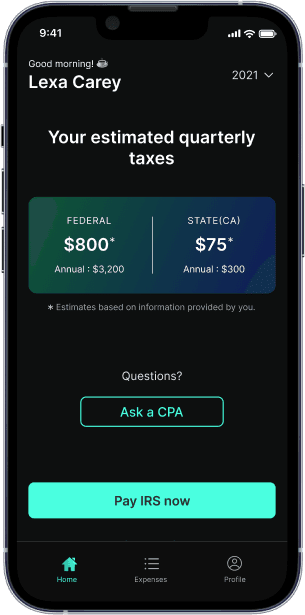
Quarterly tax deadline is Jan 15. See how much you owe penalties
1099 Tax Calculator

Are you self-employed?
This includes freelancers and business owners.
What Can I Write Off as a 1099? A Handbook on Deductions for Education and Training for Self-Employed People
You’re always looking for methods to expand your business and save money as a self-employed person, and understanding what qualifies as a business expense can be crucial. Making use of deductions for education and training is a useful tactic that is frequently disregarded. These deductions can assist you in defraying the cost of conferences, seminars, and industry events, as well as the cost of workshops, certifications, and courses. We’ll explore the realm oftraining and educational deductionsin this post, giving you a thorough overview to assist you in navigating these intricate tax advantages.
Table of contents
Understanding Education Expenses
Education expenses can be a significant burden for individuals and families, but the IRS offers various tax benefits to help offset these costs. To take full advantage of these benefits, it’s essential to understand what constitutes an education expense. Education expenses include tuition and fees, room and board, books, supplies, and equipment required for enrollment or attendance at an eligible educational institution. Additionally, expenses related to special needs services or equipment for students with disabilities may also be considered education expenses. Knowing what qualifies can help you maximize your tax savings and better manage your educational investments.
How to Deduct the Price of Workshops, Certifications, and Courses
Investing in workshops, certifications, and courses can significantly enhance your career or personal development. Fortunately, the IRS allows you to deduct the cost of these education expenses, provided they meet certain criteria. To qualify, the workshop, certification, or course must be related to your current or future job or business. This means you can deduct the cost of tuition, fees, and materials, as well as travel expenses related to the course. However, it’s crucial to keep all receipts and records of your expenses to claim the deduction. By doing so, you can ensure that you’re taking full advantage of the tax benefits available to you.
How to Deduct the Price of Workshops, Certifications, and Qualified Education Expenses
If you are aware of the IRS regulations, it is easy to write off the expense of classes, workshops, and certifications. The following are important things to remember: The maintenance or enhancement of your employment abilities must be the major goal of your schooling. The education is also deductible if it is mandated by law to keep you in your current position. The education you receive must have a direct connection to your current business. For instance, whereas a reporter can deduct a class on investigative journalism, a delivery guy cannot. These deductions can significantly lower the amount of income subject to both federal income tax and self employment tax.
No New Career Qualification: You are not eligible for a new field of employment due to the schooling. It is not deductible if you are enrolled in a course that may lead to a new career. For more detailed guidance, check out our article onhow to deduct education expenses.
Subtracting Conference, Seminar, and Industry Event Costs as a Business Expense
Professional development possibilities abound at conferences, seminars, and industry events. Not all of the costs associated with these events, though, are deductible. What you should know is as follows:
Qualified expenses include costs directly related to your business, such as travel, lodging, and registration fees.
Business-Related Expenses: You can only deduct expenses that have a direct connection to your business. Travel expenses to and from conferences, for example, are deductible if they are for business purposes but not for personal ones.
The following documentation:Maintain thorough records of your spending, including invoices and receipts. In order to claim these deductions on your tax return, you must have these documents.
Learning Resources, Such as Books, Software, and Research Instruments
Books, software, and research tools are examples of educational resources that are deductible if they are associated with your business. These resources can also qualify for education tax credits, further reducing your financial burden. To claim these costs, follow these steps:
Directly Related to Business: The content needs to have a direct connection to your existing company. For instance, you can write off the cost of web development-related books or software if you work as a freelance web developer.
The following documentation:Save all of your purchase documentation, including invoices and receipts. To claim these deductions on your tax return, you must have these documents.
Subtracting Certifications and Professional Development Courses
Certifications and professional development programs are essential for preserving and enhancing your work abilities. You can deduct these costs in the following ways: The maintenance or enhancement of your employment abilities must be the major goal of your schooling. The education is also deductible if it is mandated by law to keep you in your current position. The education you receive must have a direct connection to your current business. For instance, if you work as a freelance web developer, you can deduct a course that helps you advance your web development abilities. For more information on this, check out our guide oneducation expenses tax deductible. Additionally, if you have taken out loans to pay for these courses, you may be eligible for the student loan interest deduction.
Qualified Education Expenses
Qualified education expenses are those that are eligible for tax credits or deductions, helping to reduce the financial burden of education. These expenses include tuition and fees, room and board, books, supplies, and equipment required for enrollment or attendance at an eligible educational institution. Additionally, expenses related to special needs services or equipment for students with disabilities may also be considered qualified education expenses. To qualify, the expense must be paid to an eligible educational institution, and the student must be enrolled in a degree program or taking courses to acquire or improve job skills. Understanding what qualifies can help you make the most of available tax benefits.
Education Deductions versus Credits
When it comes to offsetting education expenses, you have two main options: education deductions and education credits. Both offer valuable tax benefits, but they work differently. Education deductions reduce your taxable income, while education credits reduce the amount of tax you owe. For example, the Lifetime Learning Credit is a tax credit that can provide up to $2,000 in tax relief, directly lowering your tax bill. On the other hand, the Tuition and Fees Deduction can reduce your taxable income by up to $4,000. Understanding the difference between these options can help you choose the best strategy to maximize your tax savings.
Tax Deductions for Student Loan Interest
Student loan interest can be a significant expense, but the IRS offers a deduction to help ease this burden. You can deduct up to $2,500 in student loan interest paid each year, provided the loan was used to pay for qualified education expenses. To qualify, you must be enrolled in a degree program or taking courses to acquire or improve job skills. Additionally, your modified adjusted gross income (MAGI) must be below $85,000 for single filers or $170,000 for joint filers. By understanding and utilizing this deduction, you can reduce your taxable income and make managing student loan debt a bit easier.
Education Deductions versus. Education Tax Credits
You can reduce the cost of your education by taking advantage of both deductions and education credits. An education credit helps reduce your tax liability for higher education expenses. They differ in their perks and eligibility requirements, nevertheless. The American Opportunity Tax Credit and the Lifetime Learning Credit are two examples ofeducation creditsthat can directly lower your tax obligation. These credits have income restrictions and phase-out levels, but their maximum values are $2,000 and $2,500, respectively. The opposite is true for deductions, which lower your taxable income. For instance, teachers can claim up to $300 in unreimbursed costs for classroom supplies and equipment under the educator expenditure deduction.
Qualification for Costs of Continuing Education and Tuition and Fees Deduction
If continuing education costs comply with IRS regulations, they can be deducted. What you should know is as follows: The maintenance or enhancement of your employment abilities must be the major goal of your schooling. The education is also deductible if it is mandated by law to keep you in your current position. The education you receive must have a direct connection to your current business. For instance, if you utilize a certain piece of software in your firm, a training that helps you become more proficient with it can be deducted. These deductions can help reduce your overall income tax liability.
Specifics of the Audience and Industry/Profession
This guide is intended for independent contractors with slightly above-beginner tax understanding who are between the ages of 21 and 60. The purpose of the content is to help readers grasp difficult words by providing examples. We will give examples that are pertinent to a variety of sectors because the focus is on particular industry or professions.
Real-World Examples
To demonstrate how these deductions operate, let’s look at a few real-world examples:
- Freelance Web Developer: You can deduct the cost of an online course if you’re a freelance web developer and you take it to advance your web development skills. This is because the training helps you maintain or enhance your employment abilities and has a clear connection to your existing business. These deductions can help reduce your overall income taxes.
- Real Estate Agent: Continuing education courses are deductible if you are a real estate agent and must finish them to keep your license. This is due to the fact that maintaining your professional standing requires the education, which is mandated by law.
- Educator: You can claim up to $300 in unreimbursed expenditures if you are a teacher and you purchase your own supplies and equipment for the classroom. This is due to the fact that instructors are able to deduct these kinds of expenses through the educator expense deduction.
Final Thoughts
Deductions for education and training are effective strategies for independent contractors trying to optimize their tax savings. The cost of classes, workshops, and certifications, as well as conference, seminar, and industry event expenses, can be written off if you follow IRS regulations and maintain thorough records of your spending. Always make sure the schooling satisfies IRS deduction requirements and is directly relevant to your existing business. With the help of this tutorial, you can better understand the world of training and educational deductions and discover how to increase your tax savings.
You may optimize your tax savings through training and education deductions by following this guidance. Keep in mind to be thorough with your documentation and make sure that every expense has a direct connection to your company. You can improve your professional development and handle the intricacies of tax deductions without going over budget with these pointers. Additionally, if you have children and are wondering about related deductions, you might be interested in learning whethertoys can be deductedas part of your business expenses.
What’s FlyFin?


Expert tax CPAs ensure 100%-accurate tax filing

A.I. finds every tax deduction, eliminating 95% of your work

On average users save $3,700