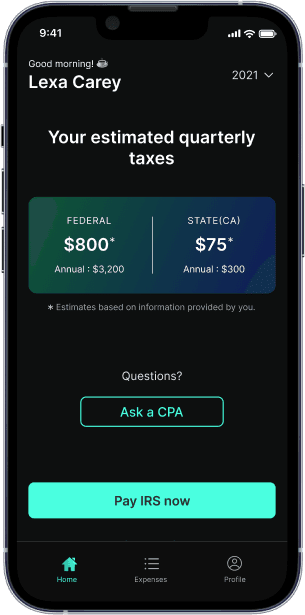
Quarterly tax deadline is Jan 15. See how much you owe penalties
1099 Tax Calculator

Are you self-employed?
This includes freelancers and business owners.
An explanation of the 15.3% self-employment tax rate
One important component of taxes for people who make money from their own companies or freelancing is the self-employment tax, also known as self employment taxes. The 15.3% self-employment tax rate is made up of two parts: 2.9% for Medicare and 12.4% for Social Security. All net earnings from self-employment, such as revenue from gig economy jobs, freelancing, or your own business, are subject to this rate. For a detailed understanding of how to calculate this tax, refer tohow to calculate my self-employment tax.
Table of contents
What is Self-Employment Tax?
Self-employment tax is a crucial component of the tax obligations for individuals who work for themselves. This tax, also known as the Self-Employment Contributions Act (SECA) tax, funds Social Security and Medicare benefits. Unlike traditional employment tax, which is withheld from an employee’s paycheck, self-employment tax is a pay-as-you-go tax. This means that self-employed individuals must pay it throughout the year as part of their income tax obligations. The self-employment tax rate stands at 15.3%, which includes 12.4% for Social Security and 2.9% for Medicare.
Who Has to Pay Self-Employment Tax?
If you earn $400 or more in net earnings from self-employment, you are required to pay self-employment tax. This includes income from freelance work, gig economy jobs, or running your own business. Unlike employees, who share the burden of employment tax with their employers, self-employed individuals must shoulder the entire tax themselves. This means that self-employment tax is not withheld from your income like regular income tax, making it essential to plan and set aside funds to meet this obligation.
How Income Tax Brackets and Self-Employment Tax Are Different
A common misconception is that self-employment tax falls under one of the income tax rates. While self-employment tax is separate, understanding your income taxes is crucial for overall financial planning and deductions. But it’s a different tax that pays for Medicare and Social Security. Self-employment tax is computed exclusively on your net profits from self-employment, as opposed to income tax, which is based on your total taxable income and uses a progressive tax structure. To see where you fall in terms of income tax, you might want to use atax bracket calculator.
Subtracting Half of Your Income from Self-Employment Tax
The ability to deduct half of your self-employment tax from your self employment income andadjusted gross income(AGI) is one advantage. Your total tax obligation may be greatly decreased by this deduction. For instance, you can lower your income tax bracket by deducting $3,533 from your AGI if your self-employment tax is $7,065.
Paying Self-Employment Tax
Paying self-employment tax is an integral part of your income tax obligations if you are self-employed. This tax is calculated on Schedule SE and reported in the “Other Taxes” section of Form 1040. It’s important to note that self-employment tax is separate from income tax and requires its own schedule. One benefit for self-employed individuals is the ability to deduct half of their self-employment tax as an adjustment to income on Form 1040. This deduction can reduce your taxable income, thereby lowering your overall income tax bill.
Effect on Deductions and Taxable Income
Your taxable income and deductions might be greatly impacted by self-employment tax. Here's how:
- Lowering Income Subject to Taxation:You lower your taxable income by subtracting half of your self-employment tax from your AGI. For instance, your AGI would be lowered by $3,533 if you were to deduct half of your $7,065 self-employment tax.
- Eligible Business Costs:Additionally, you can lower your self-employment tax bill by deducting eligible business expenses from your net earnings. For example, your taxable income would be $50,000 if your net earnings were $100,000 and your deductible costs were $50,000.
- Other Subtractions:Other deductions, like the Qualified Business Income (QBI) deduction, are also available to self-employed people. After deducting half of your self-employment tax, you can use this deduction to claim 20% of your eligible business income.
The Impact of Self-Employment Tax on 1099 Earners' Total Tax Liability
For 1099 individuals, self-employment tax can have a major impact on their total tax obligation. Here's how:
- Higher Tax Rate:The self-employment tax may cause you to fall into a higher tax rate. For instance, your self-employment tax of $7,065 would increase your total tax obligation if you are in the 22% tax bracket and had $50,000 in taxable income.
- Estimated Tax Remittances:In order to pay your federal income tax and self-employment tax, you must make anticipated tax payments throughout the year as a 1099 earner. Penalties and interest may be incurred if these payments are not made. To stay on top of your obligations, refer to thequarterly tax due dates.
- Credits and Deductions:You can use credits and deductions to lower your self-employment tax obligation. For example, you can lower your income tax bracket by deducting half of your self-employment tax from your AGI.
Filing Requirements
Self-employed individuals must navigate specific filing requirements to report their income and pay their taxes. You will need to file Schedule C to report your business income and expenses, and Schedule SE to calculate and report your self-employment tax. The self-employment tax is then reported in the “Other Taxes” section of Form 1040. Additionally, self-employed individuals are required to make estimated quarterly tax payments to prepay their income tax liability, including self-employment tax. Failing to make these payments can result in underpayment penalties, so it’s crucial to stay on top of your quarterly tax payments.
Consequences of Not Paying Self-Employment Tax
Failing to pay self-employment tax can lead to significant issues with the IRS, including penalties and interest on the unpaid tax. If you neglect to pay your self-employment tax, you may receive an IRS CP2000 Notice, which demands payment of the unpaid tax along with any penalties and interest accrued. Moreover, self-employed individuals who do not make estimated quarterly tax payments may face underpayment penalties. To avoid these consequences, it’s essential to make timely estimated tax payments throughout the year and ensure that your self-employment tax is fully paid.
How Tax Planning Can Lower Self-Employment Tax
In order to minimize your total tax payment, tax planning is essential for lowering self-employment tax. The following are some tactics:
- Maximize Deductions:Keep thorough records of your business costs to maximize your deductions. Your net earnings that are subject to self-employment tax may be greatly decreased as a result.
- Claim QBI Deduction:To lower your taxable income, claim the QBI deduction. After deducting half of your self-employment tax, you can use this deduction to claim 20% of your eligible business income.
- Payment of Estimated Taxes:To prevent fines and interest, pay your taxes on time each year. This guarantees that you are paying both your self-employment tax and your federal income tax.
- Speak with a Tax Expert:To maximize your tax plan, speak with a tax expert. They can guide you through the intricacies of self-employment tax and make sure you're utilizing all of the credits and deductions that are available.
What’s FlyFin?


Expert tax CPAs ensure 100%-accurate tax filing

A.I. finds every tax deduction, eliminating 95% of your work

On average users save $3,700