Quarterly tax deadline is Jan 15. See how much you owe penalties
1099 Tax Calculator

Are you self-employed?
This includes freelancers and business owners.
Understanding the Tax Bracket 1099: Quarterly Taxes and Income Overview for Independent Contractors
Managing your finances as a self-employed person can be a difficult undertaking. Comprehending and payingquarterly taxesis an essential component of financial management. You must submit estimated quarterly tax payments to the IRS if you are a 1099 worker, as you are probably in charge of paying taxes on your own. We’ll walk you through the steps of calculating and paying quarterly taxes in this post, avoiding penalties, and using tools to make your calculations easier.
Table of contents
What Are Quarterly Tax Payments?
Quarterly tax payments are periodic payments made to the IRS throughout the year to cover your tax liability. These payments are typically made by self-employed individuals, freelancers, and small business owners who expect to owe $1,000 or more in taxes for the year. Also known as estimated tax payments, these installments help you manage your tax bill by spreading it out over the year, rather than facing a large sum when you file your annual tax return. By making quarterly tax payments, you can avoid the stress of a hefty tax bill and stay on top of your tax obligations.
Who Needs to Pay Quarterly Taxes?
If you are self-employed, a freelancer, or a small business owner expecting to owe $1,000 or more in taxes for the year, you need to pay quarterly taxes. This requirement applies to individuals who receive income from various sources such as freelance work, consulting, or rental properties. Even if you are an employee with a side job or additional income streams, you may still need to make estimated tax payments. Paying quarterly taxes ensures that you meet your tax obligations throughout the year and avoid any surprises come tax season.
How to Determine If You Owe Quarterly Taxes
To determine if you owe quarterly taxes, start by estimating your tax liability for the year. You can use your previous year’s tax return as a reference point or employ tax software to help with the calculations. If you expect to owe $1,000 or more in taxes for the year, you will need to make quarterly tax payments. The IRS provides Form 1040-ES, which includes a worksheet to help you calculate your estimated tax payments. By accurately estimating your tax liability, you can ensure that you make the necessary quarterly payments and avoid any penalties.
Using Your Tax Bracket to Estimate Quarterly Taxes
You must first calculate your expected tax liability for the year, including your estimated quarterly taxes. This is determined by your tax bracket and anticipated income. Here is a detailed tutorial to assist you with the calculation:
- Estimate Your Income: Make use of the income from the prior year as a benchmark. Make the necessary adjustments if you anticipate major changes.
- Subtract Deductions: Deduct any anticipated above-the-line deductions.
- Subtract Standard Deduction: Use your filing status to subtract the standard deduction.
- Compute Self-Employment Tax: Since you pay both the employer and employee components of your self-employment tax, deduct 50% of it.
- Determine Income Tax Rate: To find your income tax rate, use the 2023 tax brackets.
- Multiply by 92.35%: To account for federal income taxes, multiply your adjusted gross income by 92.35%.
- Incorporate Self-Employment Tax: Multiply the outcome by the self-employment tax rate, which is 15.3%.
- Divide by 4: To determine your projected quarterly tax payment, divide the total by 4.
For instance, your adjusted gross income might be $80,000 if you anticipate making $100,000 this year and deduct $20,000 from it. You may calculate an income tax rate of about 24% using the tax rates for 2023. The result of multiplying $80,000 by 92.35% is roughly $73,880. You then get about $11,300 after deducting 15.3% of this sum for self-employment tax. This is roughly $2,825 every quarter when divided by 4.
IRS Quarterly Estimated Payment Deadlines
It’s essential to comprehend IRS deadlines in order to prevent penalties. The projected quarterly tax payment dates for 2024 are as follows:
- The estimated tax payment is due on April 15, 2024 (January 1st to March 31st).
- The estimated tax payment is due on June 17, 2024 (April 1st–June 30th).
- The estimated tax payment is due on September 16, 2024, between July 1st and September 30th.
- October 1st–December 31st: January 15, 2025 is the estimated date of the tax payment.
To avoid any fines or late fees, be sure to put these dates on your calendar. It is crucial to pay estimated taxes by these deadlines to avoid penalties.
How to Use 1099 Income to Determine Quarterly Taxes
There are multiple procedures involved in calculating quarterly taxes using your 1099 income:
- Compile Your Data: Compile all of your revenue reports from platforms or clients.
- Estimate Your Income: Start with your income from the prior year and make any necessary adjustments.
- Determine Your Tax Liability: To find out how much you owe each quarter, use the IRS’s Estimated Tax Worksheet (Form 1040-ES).
- Complete Form 1040-ES: Enter your projected income and tax obligation on this form.
- Make Your Payment: To make your payment, choose one of the authorized IRS payment methods.
To determine how much you owe each quarter, you would divide your total expected tax burden for the year by four, for example, if you earned $10,000 in the first quarter and anticipate earning $20,000 in the second. Based on these calculations, individuals need to pay estimated quarterly taxes to avoid penalties.
Making Correct Quarterly Payments to Avoid Penalties
Safe Harbor Guidelines for Estimated Tax Calculation
Safe harbor guidelines are provided by the IRS to help you stay out of trouble. The U.S. tax system operates on a pay-as-you-go basis, requiring individuals, especially self-employed workers, to make quarterly estimated tax payments throughout the year to avoid penalties and interest. Penalties can be avoided by paying either:
- 90% of the Current Year’s Tax Liability: Make payments equal to 90% of your tax liability for the current year.
- 100% of Last Year’s Tax Liability: If your adjusted gross income was $150,000 or less ($75,000 or less if you’re married filing separately), you must pay 100% of your tax liability from the previous year.
- 110% of Last Year’s Tax Liability: If your adjusted gross income exceeded $150,000 ($75,000 if you’re married filing separately), you must pay 110% of your tax liability from the previous year.
Qualified Business Income Deductions
As a self-employed individual or small business owner, you may be eligible for qualified business income (QBI) deductions. These deductions allow you to reduce your taxable income by up to 20% of your qualified business income, thereby lowering your tax liability and your quarterly tax payments. To qualify for QBI deductions, you must meet certain criteria, such as having a qualified business and staying within specific income limits. Taking advantage of QBI deductions can significantly reduce your tax burden and make paying quarterly taxes more manageable.
Apps and Tools for Quarterly Tax Calculation
The process of computing your quarterly taxes can be made simpler with the aid of a number of tools and applications. Here are several examples:
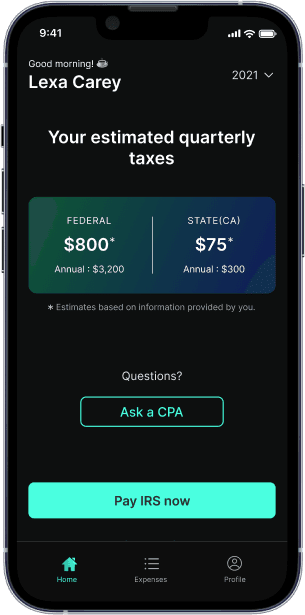
FlyFin:FlyFinis an app made especially for independent contractors and freelancers. It facilitates tax computation, payment processing, and income and cost tracking.
IRS Form 1040-ES: You can determine your estimated tax liability using the IRS’s Form 1040-ES worksheet.
You can keep organized and make sure you’re paying people on time by using these tools. These tools can help individuals calculate and make their estimated quarterly tax payments accurately.
Saving Money on Quarterly Taxes
There are several strategies to save money on quarterly taxes. One effective method is to keep meticulous records of your business expenses, which can help you maximize your deductions on your tax return. Utilizing tax software can also assist in accurately estimating your tax liability and ensuring timely quarterly payments. Additionally, hiring a tax professional can provide expert guidance on navigating tax laws and identifying opportunities to reduce your tax liability. By implementing these practices, you can save money on quarterly taxes and avoid penalties and interest charges from the IRS.
Final Thoughts
Although handling your finances as a self-employed person can be difficult, knowing and filing your taxes on time each quarter is essential to maintaining IRS compliance. You may be sure you’re paying correctly and avoid penalties by using the appropriate tools and following these instructions. Don’t forget to keep detailed records, make calendar reminders, and analyze your income and expenses on a regular basis. You may become an expert in 1099 income and quarterly taxes with the correct help and resources. Additionally, understanding and managing estimated quarterly taxes is crucial to ensure timely tax payments and avoid any end-of-year surprises.
Extra Advice
To maintain organization, make sure that all of your financial records and paperwork are in order. This will enable you to precisely track your earnings and outlays.Speak with an Expert: Think about speaking with a tax expert if you have any questions regarding any aspect of the procedure. They can guide you through any complexities and offer tailored advice.Review and Adjust: Examine your anticipated taxes on a regular basis and make any necessary adjustments. By doing this, you may be sure you’re paying correctly and avoid underpayment fines.
You may do your quarterly taxes with confidence and maintain IRS compliance by adhering to these pointers and recommendations. Keep in mind that being responsible and ready for your financial future is more important than just paying taxes. Additionally, some regions like90210 are encouragingfreelancers to have health insurance, which can impact your financial planning. If you expect to owe $1,000 or more in federal income taxes, make sure to pay estimated quarterly taxes to avoid penalties and manage your tax obligations effectively.
What’s FlyFin?


Expert tax CPAs ensure 100%-accurate tax filing

A.I. finds every tax deduction, eliminating 95% of your work

On average users save $3,700