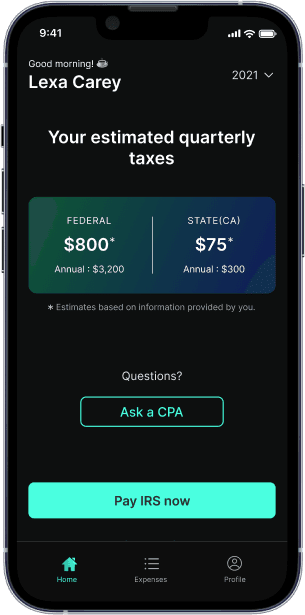
Quarterly tax deadline is Jan 15. See how much you owe penalties
1099 Tax Calculator

Are you self-employed?
This includes freelancers and business owners.
Write Offs Rules for Independent Contractors: 1099 Workers' Home Office Deductions
Understanding what constitutes a home office for tax purposes is crucial before getting into the specifics of home office deductions. Self-employed people are permitted by the IRS to claim a deduction for costs associated with a specific area that is utilized only for business purposes, which are considered deductible expenses. This area could be a garage conversion, an extra room, or a portion of your living room. The space must be routinely and solely utilized for business purposes in order to be eligible. You might not be able to claim the deduction, for instance, if you utilize a spare bedroom for both work and guests. You might still be eligible, though, if you use a particular space for inventory storage or daycare services. Learn more abouthome office tax deduction for artiststo see if it applies to your situation.
Table of contents
Understanding Business Expenses and Tax Deductions
As a self-employed individual, it’s essential to understand the concept of business expenses and tax deductions. Business expenses are costs incurred while operating a business, and tax deductions are expenses that can be subtracted from taxable income to reduce the amount of income tax owed. Understanding the difference between personal and business expenses is crucial to ensure accurate tax reporting and maximize tax savings.
Business expenses can include anything from office supplies and equipment to travel and advertising costs. These expenses are necessary for the operation of your business and can significantly reduce your taxable income. By deducting these expenses, you lower the amount of income that is subject to income tax, which can result in substantial tax savings.
It’s important to keep detailed records of all business expenses to ensure they are accurately reported on your tax return. This includes keeping receipts, invoices, and bank statements that document each expense. By doing so, you can confidently claim these deductions and reduce your overall tax bill.
Types of Business Expenses
Business expenses can be categorized into various types, each with its own set of deductible costs. Understanding these categories can help you identify all possible deductions and maximize your tax savings:
- Operating Expenses: These are the day-to-day costs of running your business, such as rent, utilities, office supplies, and salaries. These expenses are essential for maintaining business operations and are fully deductible.
- Capital Expenses: These include costs related to purchasing or improving long-term assets like equipment, vehicles, or property. While these expenses are not fully deductible in the year they are incurred, they can be depreciated over the useful life of the asset.
- Travel Expenses: If you travel for business purposes, you can deduct expenses such as transportation, lodging, and meals. It’s important to keep detailed records of your travel, including the purpose of the trip and the expenses incurred.
- Advertising Expenses: Promoting your business through online ads, print ads, and promotional materials can be deducted as advertising expenses. These costs are essential for attracting new customers and growing your business.
- Insurance Expenses: Business insurance, such as liability insurance, property insurance, and workers’ compensation insurance, is also deductible. These expenses protect your business from potential risks and liabilities.
By categorizing and tracking these expenses, you can ensure that you are claiming all eligible deductions and reducing your taxable income.
Understanding Home Office Deductions
As a self-employed individual, you may be eligible to deduct a portion of your home expenses as a business expense. This is known as the home office deduction, which includes various deductible expenses. To qualify for the home office deduction, you must use a dedicated space in your home regularly and exclusively for business. This can include a home office, studio, or workshop.
The home office deduction can encompass various expenses such as mortgage interest, rent, utilities, repairs, and maintenance. You have two options for calculating this deduction. The simplified option allows a deduction of $5 per square foot of home used for business, up to 300 square feet. Alternatively, you can use the actual expenses method, which involves calculating the actual costs associated with your home office.
Accurate record-keeping is crucial for claiming the home office deduction. Keep receipts, invoices, and bank statements related to your home office expenses. Additionally, take photos of your home office space and maintain a log of the time you spend working from home. This documentation will be invaluable when it’s time to file your taxes.
How to Determine Your Workspace's Square Footage
It's easy to figure out how many square feet your workspace is. Here is a detailed guide:
- Measure Your Space: Determine the width and length of the space you occupy for work. To find the square footage, multiply these two figures together.
- Find the Percentage: Find out what proportion of your house is used for business if your home office is a part of a larger place. For example, your business-use proportion is 15% if your home office occupies 300 square feet of a 2,000-square-foot house.
- Note Your Measurements: Document your calculations and measurements. When it's time to submit your taxes, this will be helpful.
Home Office Deduction: Simplified vs. Real Expense Methods
The simplified technique and the actual expense method are the two primary approaches for claiming home office deductions, each involving different deductible expenses.
Understanding these methods is crucial for maximizing tax deductions for independent contractors.
Condensed Approach
Real Cost Approach
IRS Home Office Exclusive Use Test
To ascertain whether a location is eligible for home office deductions and deductible expenses, the IRS uses an exclusive use test. Regular and solely business use of the area is required. The following are some exclusions:
- Day Care Services: If you have a license or certification and offer day care services out of your home office, you may still be eligible for the deduction.
- Storage of Inventory: You may also be eligible if you utilize the area to keep product samples or inventory.
Income Tax and Business Expenses
Income tax is a tax on an individual’s or business’s taxable income. Business expenses can be used to reduce taxable income, which in turn reduces the amount of income tax owed. The self-employment tax deduction allows self-employed individuals to deduct half of their self-employment tax liability. Additionally, business expenses can be used to reduce net earnings, which can also reduce the amount of self-employment tax owed.
For example, if you have $50,000 in business income and $10,000 in business expenses, your taxable income would be reduced to $40,000. This reduction in taxable income can significantly lower your income tax bill. Furthermore, by deducting half of your self-employment tax, you can further reduce your overall tax liability.
It’s important to keep detailed records of all business expenses to ensure they are accurately reported on your tax return. This includes keeping receipts, invoices, and bank statements that document each expense. By doing so, you can confidently claim these deductions and reduce your overall tax bill.
Monitoring Home-Based Deductible Business Expenses
When it comes to home office deductions, keeping track of expenditures is essential. Proper tracking and management of these deductible expenses are essential for maximizing deductions for independent contractors. Here are some pointers:
- Separate Bank Account: To make it easier to monitor your activities, open a separate bank account for your business spending.
- Credit Card: Make use of a credit card that is intended only for commercial purposes. This will help you maintain the organization of your statements and receipts.
- Invoices and Receipts: Save all invoices and receipts pertaining to your business expenditures. When you file your taxes, these will be required.
- Software: To make it easier to create reports and keep track of your spending, think about utilizing accounting software.
Record-Keeping and Tax Preparation
Accurate record-keeping is essential for tax preparation and ensuring that all eligible business expenses are claimed. Self-employed individuals should keep records of receipts, invoices, and credit card statements to support deductions. It’s also important to keep records for at least three years in case of an audit. Tax preparation software and consulting with a tax professional can also help ensure accurate tax reporting and maximize tax savings.
Using a separate bank account and credit card for business expenses can simplify the record-keeping process. This separation makes it easier to track business expenses and ensures that personal and business expenses are not mixed. Additionally, using accounting software can help you organize and categorize expenses, making tax preparation more efficient.
Consulting with a tax professional can provide valuable insights and ensure that you are taking advantage of all available deductions. A tax professional can help you navigate complex tax laws, identify potential deductions, and ensure that your tax return is accurate and complete.
By maintaining accurate records and seeking professional advice, you can confidently prepare your tax return and maximize your tax savings.
Final Thoughts
As a 1099 worker, you can save a lot of money on taxes by claiming home office deductions, which can drastically lower your taxable income. You may optimize your deductions by knowing what constitutes a home office, precisely determining your square footage, selecting between the simplified and actual expense methods, keeping track of your internet and utility costs, and understanding your deductible expenses. To make sure you qualify for the deductions you claim, don’t forget to maintain thorough records of every item you incur. You may confidently negotiate the difficulties of home office deductions if you have the appropriate information and resources. Be aware of whetherhome office deductions lead to an audit riskto ensure peace of mind. Additionally, don’t forget that health insurance premiums can also be deducted as a business expense.
Extra Advice on Self Employment Tax
Speak with a Tax Professional: It’s always a good idea to speak with a tax professional if you have any questions about any aspect of the procedure. They can make sure you’re receiving the most deductions possible and assist you in navigating the complexities of home office deductions. Consulting a tax professional can also help you understand and claim the qualified business income deduction and identify deductible expenses.
Maintain Records: Accurate records must be kept. Ensure that all of your measurements, invoices, and receipts are recorded. Your tax filing process will go considerably more smoothly as a result. Use distinct accounts and credit cards for business expenses to maintain organization. This will make it easier for you to keep track of your spending and guarantee that you don’t overlook any deductions. You can discover the keys to optimizing your home office deductions and lowering your tax burden as a 1099 worker by heeding these pointers and comprehending the rules described in this article.
What’s FlyFin?


Expert tax CPAs ensure 100%-accurate tax filing

A.I. finds every tax deduction, eliminating 95% of your work

On average users save $3,700