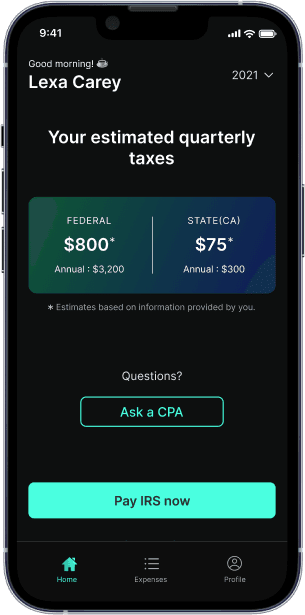
Quarterly tax deadline is Jan 15. See how much you owe penalties
1099 Tax Calculator

Are you self-employed?
This includes freelancers and business owners.
What Can I Write Off as a 1099? Health Insurance Rates for Independent Contractors
Managing your finances as a self-employed person can be a difficult undertaking. The payments for your health insurance are among the biggest costs you will incur. By deducting these premiums from your taxes, you can lessen the financial strain. In this post, we'll walk you through theprocess of deducting health insurance premiums, including dental and family coverage, and we'll look at the marketplace's tax credits.
Table of contents
Marketplace-Based Tax Credits for Health Insurance
You may qualify for premium tax credits and other discounts if you buy health insurance through the marketplace. Your projected household income for the year you're receiving coverage is the basis for these credits. To be eligible for these credits, you must give the marketplace an estimate of your household income. For example, you should give your best estimate of your household income if you work for yourself and your income fluctuates. To prevent any penalties or extra expenses, you should update your projected income as soon as possible if your expected revenue changes throughout the year.
Eligibility for Self-Employed Health Insurance Deduction
You must fulfill certain requirements in order to be eligible for the self-employed health insurance deduction. Meeting these requirements allows you to claim a health insurance premium deduction, which can lower your overall tax liability. Here are some important things to think about: It is required that you record net profit income as a farmer on Schedule F or as a lone owner on Schedule C. It is not possible for you to have had access to employer-sponsored health insurance. Both you and your spouse are covered by this.Qualifying Insurance: The insurance coverage needs to satisfy IRS requirements, such as being tax-qualified and offering the bare minimum of necessary coverage.
Health Insurance Options for Independent Contractors
As an independent contractor, finding affordable health insurance options can be challenging. However, there are several avenues you can explore to secure the necessary coverage at a reasonable cost. Understanding these options can help you make informed decisions about your health insurance.
Affordable Health Insurance Options
Health Insurance Marketplaces and Independent Contractors
Dental and Vision Insurance Deductions
You can claim your self-employed health insurance deduction for dental and vision insurance premiums. To be eligible, the insurance plan must, however, fulfill IRS requirements. This involves offering minimal essential coverage and being tax-qualified. For instance, as long as the plans satisfy IRS requirements, you can deduct $1,500 for dental insurance and $2,000 for vision insurance from your total health insurance deduction.
Final Thoughts
It can be difficult to manage health insurance costs as a self-employed person, but there are strategies to lessen the financial strain. You can reduce your taxes by knowinghow to deduct health insurance premiums, such as those for family coverage and dental insurance. Further savings might be obtained by looking into tax credits that are offered through the marketplace. To guarantee adherence to IRS guidelines and optimize your tax advantages, don't forget to meticulously compute your deductions. Speaking with a tax expert can help you make well-informed decisions regarding your deductions by offering individualized advice based on your unique situation.
Extra Advice
- Estimate Income Carefully: Give your best estimate of your household's income when calculating marketplace savings. To prevent fines or extra expenses, update your anticipated income as soon as your income changes throughout the year. Examine the qualifications for the plan. To be eligible for the deduction, be sure your dental and vision insurance policies satisfy IRS requirements. This involves offering minimal essential coverage and being tax-qualified.
- Speak with an Expert: Speak with a tax expert if you have any questions regarding any aspect of the procedure. They can make sure you're utilizing all of the tax credits and deductions that are available to you and assist you in navigating the complexity of the self-employed health insurance deduction. You may efficiently manage your health insurance premiums and lower your overall tax burden as a self-employed individual by adhering to these rules and being aware of thequalifying requirements and tax creditsthat are available. Additionally, exploringthe best health insurances for self-employedindividuals can further enhance your understanding of available options. Lastly, consider learning aboutdeductions for self-employedindividuals to maximize your tax benefits.
What’s FlyFin?


Expert tax CPAs ensure 100%-accurate tax filing

A.I. finds every tax deduction, eliminating 95% of your work

On average users save $3,700