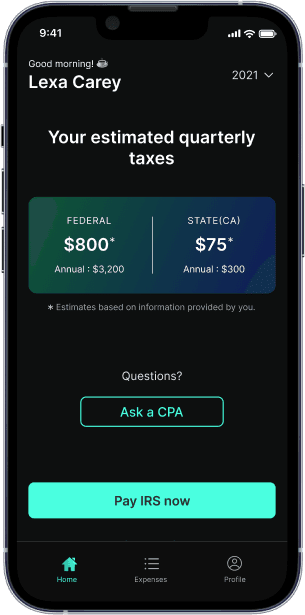
Quarterly tax deadline is Jan 15. See how much you owe penalties
1099 Tax Calculator

Are you self-employed?
This includes freelancers and business owners.
Using a DoorDash Tax Calculator for Filing Quarterly Taxes as a Driver
You can choose your own hours and how much money you can make as a DoorDash driver. In contrast to regular employees, this freedom entails a more complicated tax status. Since you are regarded as an independent contractor, you are self-employed and are responsible for filing your own taxes. We’ll guide you through the quarterly tax filing process as a DoorDash driver in this article to make sure you stay in compliance and understand how to pay taxes on your earnings.
Table of contents
Understanding DoorDash Taxes
As a DoorDash driver, understanding your tax obligations is crucial to avoid any surprises come tax season. Since you are considered self-employed, you have specific tax responsibilities that differ from those of traditional employees.
What is Self-Employment Tax?
What are Estimated Quarterly Taxes and Why Are They Required to Be Filed?
Self-employed people, such as DoorDash drivers, pay estimated taxes quarterly to the IRS to cover their annual tax obligations. It is essential that you make these payments in order toavoid fines and interestbecause, unlike regular employees, you do not have taxes deducted from your profits.
Reasons for Filing Them
DoorDash 1099 Forms
When tax season rolls around, you will receive specific forms that report your earnings as a DoorDash driver. Understanding these forms is essential for accurate tax filing.
1099-NEC vs 1099-K
How to Use DoorDash Earnings to Determine Quarterly Taxes
Your quarterly taxes must be calculated in multiple steps:
- Find Out Your Annual Salary- Estimating your annual revenue is a good place to start. This covers all of your revenue from Dasher-related activities in addition to any additional income from self-employment. Take into account variables like your usual weekly income, seasonal variations, and any anticipated changes to your firm.
- Assess Your Business Expenses– List and monitor yourbusiness expenses that are deductible. This could include gas, upkeep and repairs for your car, phone and internet bills, supplies or equipment, and any other costs directly associated with your Dasher activities. Your net income is calculated by deducting these costs from your expected income.
- Do the Self-Employment Tax Calculation- You are in charge of paying the employee and employer halves of Social Security and Medicare taxes if you work for yourself. This comes to a total of 15.3% of your net self-employment income, which is your self employed tax.
Assess Your Quarterly Tax Refunds- You can compute your quarterly payments once you have your expected yearly income and self-employment tax. If you anticipate owing the IRS $1,000 or more in taxes after deducting any tax withholding and refundable credits, you mustfile an anticipated tax return.
Self-Employment Tax Rules
Navigating self-employment tax rules can be challenging, but it’s essential to ensure you meet your tax obligations and take advantage of available deductions.
As a self-employed individual, you must pay self-employment tax if your net earnings from self-employment are $400 or more. Here are some key rules to keep in mind:
- Filing Requirements: You will need to file Form 1040 and Schedule SE to report your self-employment tax. Schedule SE helps you calculate the amount of self-employment tax you owe based on your net earnings.
- Deducting Self-Employment Tax: You can deduct half of your self-employment tax as a business expense on Schedule C. This deduction helps reduce your taxable income, lowering your overall tax burden.
- Estimated Tax Payments: To avoid penalties, you must make estimated tax payments throughout the year. These payments cover your income tax and self-employment tax. You can use Form 1040-ES to calculate and make these estimated tax payments.
- Consult a Tax Professional: Given the complexities of self-employment tax, consider consulting a tax professional. They can help ensure you are in compliance with all tax laws and regulations and maximize your allowable deductions.
By understanding and adhering to these rules, you can effectively manage your self-employment tax obligations and minimize your tax burden.
Implications of Missing Quarterly Tax Payments
Not filing your taxes on time each quarter might have serious repercussions, such as:
- Penalties and Interest- Unpaid taxes are subject to penalties and interest assessments by the IRS. In addition to federal taxes, you are also responsible for paying state income taxes, which can vary depending on your state of residence. It can become ever more difficult to pay your taxes as a result of these fines, which can be significant and quickly accumulate.
- Risk of Audit- Your chances of being audited rise if you fail to pay your taxes on time each quarter. If you are in a history of not filing your taxes on time, the IRS is likely to examine your returns more closely.
IRS Apps and Tools for Quarterly Payment Management
The IRS offers a number of applications and tools to assist you in handling your quarterly payments: Unlike traditional employees who have taxes withheld from their paychecks, independent contractors must manage their own tax payments using tools like EFTPS.
EFTPS (Electronic Federal Tax Payment System)You can pay your estimated taxes electronically with the IRS’s free EFTPS program. Your payments will be processed promptly and properly thanks to our service.
Estimating Gig Workers' Potential Self Employment Tax
It can be difficult to estimate your taxes as a freelance worker. To avoid penalties, it is crucial to accurately estimate your taxes and pay quarterly taxes on time. The following advice will assist you:
Use a Tax Calculator
Monitor Your Expenses for Tax Deductions
Safe Harbor Guidelines to Prevent Fines
A safe harbor provision is offered by the IRS to protect taxpayers from fines for underpaying estimated taxes. To avoid penalties, it is crucial to accurately calculate and pay estimated taxes throughout the year. In the event that you pay either:
- 90% of your current year’s tax liability; or
- 100% of your past year’s tax liability(110% if your adjusted gross income exceeds $150,000).
If you underpay projected taxes, there won’t be any penalties applied to you.
Enrolling in Quarterly Payments using IRS Form 1040-ES
The form used to pay quarterly taxes is Form 1040-ES. This is the way to file it:
- Download the Form- To make electronic payments, use the EFTPS service or download Form 1040-ES from the IRS website.
- Complete the Form– This form needs your name, address, Social Security number, and the total amount you are paying. Additionally, the quarter for which the payment is being made must be specified.
- Submit Your Payment- You have the option of sending the form and your payment by mail or electronically using the EFTPS service. Additionally, some financial institutions let you make payments straight from your account.
Advice for DoorDash Drivers on Handling Quarterly Taxes
The management of your quarterly taxes as a DoorDash driver necessitates preparation and structure. Unlike traditional employees who have taxes withheld from their paychecks, you must manage your own tax payments as an independent contractor. The following advice will assist you:
Reserve a Segment of Your IncomeIt is advised to budget between thirty and forty percent of your revenue to pay state and federal taxes. You won’t have to pay a big tax bill at the end of the year if you do this.
Make Use of Tax DeductionsYou can deduct business expenses from your taxable income if you are a self-employed person. This covers travel expenditures, car upkeep, phone bills, and any other costs associated with your Dasher activities.
Speak with a Tax Expert- Consider speaking with a tax expert if you have any questions about any step of the procedure. They can guide you through the intricacies of self-employment taxation and make sure you’re maximizing all of your allowable deductions.
For more information on how DoorDash drivers handle their taxes, you can check out thiscomprehensive guide on DoorDash taxes.
You may make sure you’re submitting your quarterly taxes accurately and staying out of trouble by paying attention to these instructions and advice. Recall that maintaining your tax compliance is essential to a seamless tax filing procedure at the end of the year.
What’s FlyFin?


Expert tax CPAs ensure 100%-accurate tax filing

A.I. finds every tax deduction, eliminating 95% of your work

On average users save $3,700