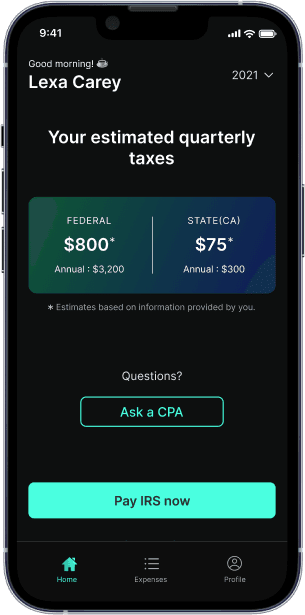
Quarterly tax deadline is Jan 15. See how much you owe penalties
1099 Tax Calculator

Are you self-employed?
This includes freelancers and business owners.
Using the DoorDash Tax Calculator to Determine Your Taxable Income
Managing taxes as a self-employed DoorDash driver can be challenging. However, you can make sure that you’re appropriately reporting your income and lowering your tax liabilities if you understand and track your business expenses and have the appropriate resources and skills. This post will outline the essential procedures for figuring out your DoorDash income for tax purposes, including how to submit your overall income, monitor tips and bonuses, and keep tabs on your spending and distance.
Table of contents
Understanding DoorDash Taxes
What taxes do DoorDash drivers pay?
As a DoorDash driver, you are considered self-employed, which means you are responsible for paying several types of taxes on your earnings. The primary tax you need to be aware of is the self-employment tax, which includes both Social Security and Medicare taxes. These taxes are crucial as they fund the Social Security and Medicare programs. In addition to self-employment tax, you will also need to pay federal income tax, which is based on your tax bracket and filing status. Depending on where you live, you may also be required to pay state income taxes. It’s important to understand these obligations to ensure you are setting aside enough money to cover your tax bill and accurately pay taxes to avoid penalties.
DoorDash Tax Forms You’ll Need to File
How much are DoorDash driver taxes?
Declaring Your Entire DoorDash Income
Knowing your total earnings is the first step in figuring out how much you need to pay in your own taxes from DoorDash.Gross earningsare the total money you have received from DoorDash before any costs or deductions are made. This number is important since it forms the basis for all of your tax computations.
DoorDash provides statements that you can utilize to determine your gross earnings. Usually, these statements list your base compensation as well as any tips you have collected for each delivery. These statements can be used as follows:
- Open the Dasher App: To begin, launch your device’s DoorDash app.
- Earnings Statements: Open the “Earnings” area and choose “Earnings Statements.”
- Select the Year: Choose the year you wish to see your profits for. You might not be able to see year selections if you’re a new Dasher.
- Download the Statement: Select the “Save” icon to get the PDF version of the statement.
You can add up the money you’ve made from DoorDash after you have your earnings statement. You will be paidgross incomefor this amount.
Estimating Business Profit
To estimate your business profit, you’ll need to calculate your total business income and subtract your business expenses. Your business income includes your DoorDash earnings, tips, and any other income related to your delivery work.
To calculate your business expenses, you can use the following categories:
- Vehicle expenses: Gas, maintenance, insurance, and depreciation.
- Equipment expenses: Phone, hot bags, and other equipment used for delivery.
- Marketing expenses: Advertising and promotional expenses.
- Insurance expenses: Liability insurance and other business-related insurance.
- Miscellaneous expenses: Tolls, parking, and other expenses related to your delivery work.
You can use a spreadsheet or accounting software to track your income and expenses and estimate your business profit. Keeping detailed records of your business expenses will help you accurately determine your taxable income and manage your tax burden effectively.
How DoorDash Driver Tips Are Taxed
Although tips are a crucial component of your income, there are certain tax ramifications associated with them. Unlike W-2 employees, DoorDash drivers do not have taxes withheld from their tips and must report them as part of their taxable income.Tipsmust be included on your tax return as they are taxable income. Here is the taxation of tips:
- Include Tips in Gross Income: Increase your gross income by any tips you may have received.
- Report Tips on Form 1099-NEC: If you make more than $600 a year, DoorDash will send you aForm 1099-NEC. This form will cover your whole non-employee income, including gratuities.
- Claim Deductions for Expenses: You are able to write off charges like equipment or mileage that are associated with receiving tips.
How to Monitor and Document Bonuses and Incentive Payments
Incentives and bonuses are extra sources of income that you must monitor and record. These may consist of:
- Pay Boosts: Certain bonuses come with a pay boost attached, raising your base pay for a set amount of time.
- Milestone Bonuses: These are bonuses given for accomplishing specific goals, such as finishing a predetermined amount of deliveries.
To monitor these bonuses:
- Examine Your Statements: Look for any incentives or bonuses on your earnings statements.
- Add to Gross Income: Raise your gross income by the amount of these bonuses.
- Report on Form 1099-NEC: Verify that your Form 1099-NEC accurately reflects these bonuses.
The Value of Monitoring Mileage and Tax Deductions
Important deductions that can drastically lower your taxable income are mileage and costs. Monitoring mileage and expenses is crucial for claiming tax deductions that can drastically lower your taxable income. This is how to keep tabs on them and file a report:
- Standard Mileage Deduction: For business-related travel, you may deduct 57.5 cents per mile. Driving to your initial delivery pickup, in between deliveries, and back home at the conclusion of the day all fall under this category.
- Track Expenses: Keep track of all the money you spend on work-related expenses, including gas, maintenance, auto insurance, phone bills, and other expenditures.
- Keep a Mileage Journal: Keep track of the distance you travel for DoorDash by using a mileage journal. This will assist you in figuring up the overall mileage deduction. For more detailed guidance, learnhow to track mileage for taxes.
Claiming Tax Deductions
As a DoorDash driver, you’re eligible to claim various tax deductions to reduce your taxable income. Some common deductions include:
- Vehicle expenses: You can deduct the business use percentage of your vehicle expenses, including gas, maintenance, and insurance.
- Equipment expenses: You can deduct the cost of equipment used for delivery, such as phones and hot bags.
- Marketing expenses: You can deduct advertising and promotional expenses related to your delivery work.
- Insurance expenses: You can deduct liability insurance and other business-related insurance premiums.
- Miscellaneous expenses: You can deduct tolls, parking, and other expenses related to your delivery work.
To claim these deductions, you’ll need to keep accurate records of your expenses, including receipts and invoices. You can use a tax professional or accounting software to help you claim these deductions, ensuring you maximize your tax savings and reduce your taxable income.
Monitoring Revenue and Outlays to Ensure Precise Reporting
Meticulous recording of income and expenses is necessary for accurate reporting. This helps in managing your tax burden effectively. Here’s how to go about it:
- Separate Company and Personal Spending: Make sure that your personal and company spending are kept apart. Costs associated with the business will be easy to identify and deduct as a result.
- Use a Tax Software: To assist you in keeping track of your income and expenses, think about utilizing a tax software such as FlyFin.
- Save Receipts: Save all of your business-related invoices. You can use these to back up your deductions.
Computing Earnings Using Delivery Platform Statements
You may figure out your earnings with the help of DoorDash's comprehensive statements. These statements can be used as follows:
- Download Earnings Statements: Open the DoorDash app and download your earnings statements.
- Combine Earnings: Add together all of the money you have received for each delivery.
- Include Bonuses and Gratuities: Increase your overall profits by any bonuses and gratuities.
Taking Tips and Incentives Into Account for Tax Calculations
Although tips and incentives are included in your taxable income, there are certain deductions associated with them. Here's how you can give them an explanation:
- Include Tips in Gross Income: Increase your gross income by any tips you may have received.
- Claim Deductions for Expenses: You can write off charges like equipment or mileage that are associated with receiving tips.
- Report on Form 1099-NEC: Verify that your Form 1099-NEC includes these suggestions.
Tax Forms and Reporting
How to find your 1099-NEC
At the end of each year, DoorDash will provide you with a 1099-NEC form, which details your total earnings from the platform. To find your 1099-NEC form, log into your DoorDash account and navigate to the “Tax Forms” section. Here’s a step-by-step guide to help you:
- Log In: Access your DoorDash account using your login credentials.
- Navigate to Tax Forms: Go to the “Tax Forms” section within your account settings.
- Download the Form: Locate your 1099-NEC form for the relevant tax year and download it.
If you encounter any issues accessing your form, you can contact DoorDash support for assistance. It’s crucial to review your 1099-NEC form carefully to ensure all the information is accurate and complete. This form is essential for reporting your taxable income and ensuring you pay the correct amount of taxes.
Computing Self Employment Tax on Self-Employment
Paying self-employment taxes is your responsibility as an independent contractor. Here’s how to figure these taxes out:
It is crucial to pay quarterly taxes to avoid potential penalties. Estimated tax payments are generally due on April 15, June 15, September 15, and January 15 of the following year. Accurately calculating and paying these taxes is especially important for freelancers and independent contractors who may not have taxes withheld from their income.
- Determine Net Profit: Take your gross income and deduct business expenditures to find your net profit.
- Calculate Self-Employment Tax: To find your self-employment tax liability, multiply your net profit by the self-employment tax rate, which is currently set at 15.3% and includes Social Security and Medicare taxes. For a comprehensive understanding, explore more aboutself-employment tax.
- Report on Schedule SE: On Schedule SE of your tax return, report the self-employment tax.
Paying Taxes as a 1099 Contractor
As a DoorDash driver, you’re considered a 1099 contractor, which means you’re responsible for paying your own taxes. You’ll need to pay self-employment tax, which includes Social Security and Medicare taxes, as well as income tax on your earnings.
You can pay your taxes quarterly using Form 1040-ES, which is due on April 15th, June 15th, September 15th, and January 15th of the following year. You can also make estimated tax payments online or by phone.
It’s essential to keep accurate records of your income and expenses to ensure you’re paying the correct amount of taxes. You can use a tax professional or accounting software to help you with your tax obligations, ensuring you pay self-employment tax and other taxes on time and avoid any penalties.
Using the DoorDash Tax Calculator
The DoorDash tax calculator is a tool that helps you estimate your tax liability based on your earnings and expenses. The calculator takes into account your business income, expenses, and tax deductions to provide an estimate of your tax bill.
To use the calculator, you’ll need to enter your business income, expenses, and tax deductions. The calculator will then provide an estimate of your tax liability, including your self-employment tax and income tax.
Keep in mind that the calculator is only an estimate, and your actual tax liability may vary depending on your individual circumstances. It’s always a good idea to consult with a tax professional to ensure you’re taking advantage of all the deductions you’re eligible for and accurately estimating your tax bill.
Determining Your Tax Impact
Tax Returns for DoorDash Drivers
As a DoorDash driver, there are various stages involved in filing taxes. Here's how to go about it:
- Collect Forms: Compile all required documentation, such as your Form 1099-NEC.
- Calculate Taxable Income: Deduct your deductions from your gross income to determine your taxable income.
- File Form 1040: Send your self-employment income and taxes to the IRS by filing Form 1040.
- Pay Estimated Quarterly Taxes: You must make estimated quarterly tax payments if you anticipate owing self-employment taxes totaling at least $1,000. For more insights, see how muchindependent contractors pay in taxescompared to other entities.
Final Thoughts
Paying taxes on DoorDash income necessitates careful consideration of all the tax ramifications. You may be sure that you're appropriately reporting your income and lowering your tax obligations by adhering to these guidelines. Don't forget to record your gross pay, mileage, tips, bonuses, and costs. To compute your earnings and make sure you're including all relevant information on your tax return, use the DoorDash statements. With the correct resources and understanding, you can confidently navigate the tax world. For the latest updates, check out thetax law changes for 2024.
Extra Advice from a Tax Professional
- Set Away 25-30% for Taxes: To help you avoid rushing when tax deadlines arrive, it is suggested to set away 25-30% of your profits for taxes.
- Use a Tax Software: To assist you with the tax filing procedure, think about utilizing tax software such as FlyFin.
- Speak with a Tax Professional: It’s wise to consult a tax professional if you have any questions about any aspect of the tax filing procedure. They can offer you tailored guidance.
These pointers and recommendations will help you navigate the challenges of figuring up DoorDash income for tax purposes. Recall that maintaining compliance with tax regulations and reducing your tax responsibilities depend on proper reporting.
What’s FlyFin?


Expert tax CPAs ensure 100%-accurate tax filing

A.I. finds every tax deduction, eliminating 95% of your work

On average users save $3,700