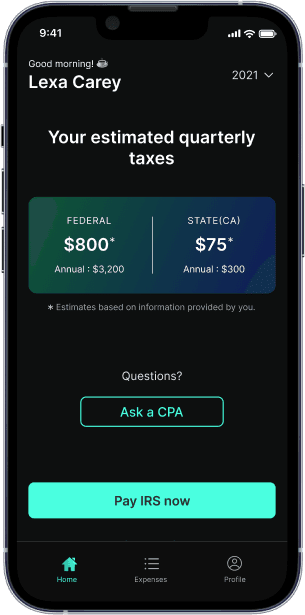
Quarterly tax deadline is Jan 15. See how much you owe penalties
1099 Tax Calculator

Are you self-employed?
This includes freelancers and business owners.
With an LLC, Do You Pay Self-Employment Tax? Determining LLC Owners' Responsibilities
Because it directly affects their entire tax burden,self-employment taxis a crucial factor for LLC owners. Self-employed people, such as LLC owners, are responsible for paying both halves of the Social Security and Medicare taxes under the Federal Insurance Contributions Act (FICA), in contrast to employees whose employers pay half of them. This indicates that they pay 15.3% of their net self-employment income overall, which includes 2.9% for Medicare and 12.4% for Social Security.
Table of contents
What is Self-Employment Tax?
Self-employment tax is a federal tax levied on the net earnings from self-employment, which includes income from a trade or business, as well as distributive shares of income from a partnership or limited liability company (LLC). This tax is crucial as it funds Social Security and Medicare, ensuring that self-employed individuals receive the same benefits as employees. The self-employment tax rate stands at 15.3% of net earnings, comprising 12.4% for Social Security and 2.9% for Medicare. This means that if you are self-employed, you are responsible for paying both the employer and employee portions of these taxes.
Who is Subject to Self-Employment Tax?
Self-employment tax applies to a variety of individuals who earn income through self-employment. This includes sole proprietors, single-member LLCs, partners in a partnership or multi-member LLC, and members of a limited liability company (LLC) who are treated as self-employed for federal income tax purposes. Essentially, if you are running your own business or are part of an LLC and not receiving a W-2 from an employer, you are likely subject to self-employment tax. Employees, on the other hand, have their Social Security and Medicare taxes withheld by their employer, which exempts them from paying self-employment tax.
Using a Calculator to Estimate the 15.3% Self-Employment Tax
With the correct tools, calculating how to pay self employment taxes can be simple. You may estimate your tax liability using a number of online calculators. These calculators apply the 15.3% rate in accordance with your net self-employment earnings. Since only 92.35% of net profits are subject to self-employment tax, for instance, you would compute 92.35% of $100,000 earned from your firm and then apply the 15.3% rate to that amount.
Paying Self-Employment Tax
Paying self-employment tax is typically done on a quarterly basis using Form 1040-ES, Estimated Tax for Individuals. The due dates for these quarterly payments are April 15th for the first quarter, June 15th for the second quarter, September 15th for the third quarter, and January 15th of the following year for the fourth quarter. While it is possible to pay self-employment tax annually using Form 1040, Individual Income Tax Return, making quarterly payments can help you avoid penalties and interest. This proactive approach ensures that you stay on top of your tax obligations throughout the year.
Taking Half of Your Personal Return's Self-Employment Tax Off
The ability to deduct half of self-employment taxes on your personal tax return is one advantage. This implies that you can deduct $7,650 from your gross income if you pay $15,300 in self-employment tax. This deduction can minimize your total tax bill by lowering your taxable income.
Making Plans for Higher-Income Earners' Additional Medicare Tax
You can also be liable for an additional Medicare tax if your income exceeds a specific threshold. If your net self-employment income exceeds $200,000 for single filers or $250,000 for joint filers in 2024, you are subject to this extra tax. The sum over these levels is subject to an extra tax of 0.9%.
Tax Benefits That Lower Self-Employment Tax Liability
Even though self-employment taxes can be high, there are a number ofdeductionsthat can lower your obligation on your net business income. These are a few typical deductions:
- Home Office Deduction:You can write off a portion of your rent or mortgage interest and utilities if you utilize a certain area of your house solely for work. Nonetheless, the area needs to be well-defined and utilized only for business purposes.
- Mileage of a Business-Related Vehicle:Business trips can be written off using either actual expenses or the normal mileage rate. To be eligible for this deduction, you must maintain thorough records of your travel and spending.
- Expenses for the business:Office supplies, equipment, and professional fees are examples of regular and essential business expenses that can be subtracted from your gross income. To guarantee correct deductions, keep thorough records of these costs.
Exceptions to Self-Employment Taxes
There are certain exceptions to self-employment taxes that may apply to specific situations. For instance, limited partners in a partnership or LLC who do not participate in the business are generally exempt. Additionally, members of an LLC who are treated as employees for federal income tax purposes do not have to pay self-employment tax. Income from real estate rental activities is also typically exempt unless the taxpayer is a dealer in real estate or provides services to the occupant. Certain retirement payments to LLC members may also be exempt, provided they meet specific requirements. Consulting with a tax professional can help you determine if any of these exceptions apply to your situation.
LLC Owners' IRS Form 1040 Schedule SE
You must useIRS Form 1040 Schedule SEto record self-employment tax. For federal tax purposes, a single-member LLC is typically treated as a disregarded entity, meaning it does not pay income tax at the entity level. Instead, the LLC's income is reported on the owner's personal tax return. Your self-employment tax is computed on this form using your net self-employment income. If you anticipate owing more than $1,000 in taxes at the time of filing your return, you will also need to fill out Form 1040-ES to make anticipated tax payments during the year.
Consequences of Not Paying Self-Employment Tax
Failing to pay self-employment tax can lead to significant penalties and interest. Late payment penalties can be as high as 47.6% of the unpaid tax, and interest on the unpaid tax can accrue daily. Additionally, not paying self-employment tax can result in the loss of Social Security benefits, as these taxes fund your future benefits. There is also the risk of a potential audit and examination by the IRS, which can be both time-consuming and stressful. To avoid these consequences, it is crucial to make timely payments and file accurate tax returns.
By understanding and adhering to these guidelines, LLC owners can effectively manage their self-employment tax responsibilities, ensuring compliance and financial stability.
Useful Advice for LLC Owners
- Maintain Accurate Records:Accurate tax computations depend on keeping thorough records of your company’s earnings and outlays, which is crucial for managing llc self employment taxes. This covers mileage logs, invoices, and receipts.
- Use Tax Calculators:To determine your self-employment tax liability, use internet tax calculators. You can use these tools to learn how your tax responsibilities change depending on your income and expenses.
- Plan for Quarterly Payments:Use Form 1040-ES to make quarterly estimated tax payments if you anticipate owing more than $1,000 in taxes at the time of filing your return. This keeps you on top of your tax responsibilities and helps you avoid penalties.
- Discover Deductions:Utilize the deductions that are available to lower your taxable income. This covers business-related automobile miles, home office deductions, and other regular and required business expenses.
Final Thoughts
Understanding the 15.3% rate, applying it to your net earnings, and utilizing the available deductions are all part of calculating self-employment tax for LLC owners. You may efficiently handle your self-employment tax responsibilities by using tax calculators, maintaining thorough records, and making plans for quarterly payments. To reduce your responsibility and make sure you are in accordance with IRS requirements, don’t forget to investigate all of your eligible deductions.
You can confidently negotiate the difficulties of self-employment tax by adhering to these guidelines and maintaining awareness of your tax responsibilities. Knowing how to compute and handle your self-employment tax is crucial for preserving financial stability and maximizing the financial performance of your company, regardless of your level of experience as an entrepreneur. This is especially important if you operate as a single member llc, as these entities are treated as disregarded entities by the IRS and are subject to self-employment taxes. For more information onself-employment tax laws, you can explore additional resources.
What’s FlyFin?


Expert tax CPAs ensure 100%-accurate tax filing

A.I. finds every tax deduction, eliminating 95% of your work

On average users save $3,700