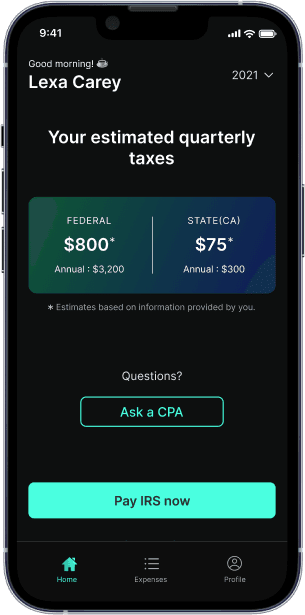
Quarterly tax deadline is Jan 15. See how much you owe penalties
1099 Tax Calculator

Are you self-employed?
This includes freelancers and business owners.
Home Office Deduction: Who Is Eligible?
Two requirements must be fulfilled in order to be eligible for the home office deduction: A designated section of your house must be used for business operations on a regular and exclusive basis. This implies that you are unable to use the area for both personal and professional purposes. For instance, you cannot claim the deduction for a spare bedroom that you utilize for both guest rooms and office purposes.
Table of contents
What is the Home Office Tax Deduction?
The home office tax deduction is a valuable tax benefit that allows self-employed individuals and small business owners to deduct a portion of their home expenses as a business expense on their tax return. This deduction can significantly reduce your taxable income and lower your overall tax liability. To qualify for the home office tax deduction, the space in your home must be used regularly and exclusively for business purposes. This means that the area should be dedicated solely to your business activities and not used for any personal purposes. By meeting these criteria, you can take advantage of this deduction and potentially save a substantial amount on your taxes.
Guidelines for Staff Members Pursuing a Home Office Deduction (If Relevant)
There are certain exceptions to the general rule that employees cannot deduct unpaid business expenditures, such as home office costs. You can only deduct expenses associated with your self-employment revenue if you work from home as both an employee and a self-employed person. Self-employed individuals must also consider self-employment tax, which includes contributions to Social Security and Medicare. For example, you can only deduct the costs associated with your side business if you use a separate room for both your side business and your W-2 job [2][3].
Qualifications for Independent Contractors and Small Business Owners
If they meet the regular and exclusive use requirements, independent contractors and small business owners are frequently eligible for the home office deduction. This involves using a specific area for business-related tasks like running a small business, consulting, or freelancing. Home office expenses can include utilities, insurance, and repairs, which are necessary for maintaining the home office. As long as it is utilized only for commercial purposes, the area may be a distinct building, such as a detached garage or shed.
Circumstances in Which Gig Economy Employees Could Be Eligible for a Deduction
If they have a designated workspace, gig economy workers—like Uber drivers or independent contractors—may also be eligible for the home office deduction. For instance, you may be eligible to deduct a portion of your living room as your home office if you utilize that area to handle client communications or your rideshare schedule. Gig economy workers should be aware of the specific requirements and potential tax benefits of claiming home office tax deductions. The area must still satisfy the requirements for regular and exclusive usage, but you can learn more about tax deductions for rideshare drivershere.
Figuring Out the Deduction for Home Office Expenses
You must figure out how much you can deduct after determining that you are eligible for the home office deduction. There are two approaches:
- Simplified way: This is a simple way that lets you deduct up to $1,500 a year, or $5 per square foot of home office space. For instance, your deduction would be $375 ((300 x $5) x 0.25), if you work from home for three months out of the year and have a 300-square-foot home office.
- TheActual Expense Methodentails figuring out what proportion of your house is used for business and adding that amount to your overall home expenses. This method involves calculating the actual expenses related to the business use of your home, such as mortgage interest, property taxes, insurance, and utilities. You can deduct indirect expenses, such as mortgage interest and utilities, based on the percentage of the home used for business purposes. This covers utilities, insurance, repairs, and rent or mortgage interest. You can deduct mortgage interest as part of the actual expenses method. This method requires a detailed understanding of your home expenses, but the potential tax savings can make it well worth the effort. Direct expenses, such as painting or repairs specifically for the home office, can be deducted in full. Indirect expenses need to be prorated based on the percentage of the home used for business. The simplified method allows for a flat deduction while still permitting the claim of home-related itemized deductions on Schedule A. For example, you can deduct 15% of your total home expenses if you use 15% of your house for business. If you’re interested in learning about writing off part of your mortgage for a home office, you can find more informationhere.
You can take advantage of the home office deduction and reduce your tax liability by adhering to these rules and making sure you fulfill the regular and exclusive use requirements.
Actual Expense Method
Business Expenses vs. Personal Expenses
When calculating the home office tax deduction, it’s crucial to distinguish between business expenses and personal expenses. Business expenses are costs that are directly related to your business operations, such as office supplies, equipment, and travel expenses. These expenses can be deducted from your business income, reducing your taxable income. On the other hand, personal expenses are costs that are not related to your business, such as groceries, entertainment, and personal care expenses. These cannot be deducted as business expenses. Keeping a clear separation between these types of expenses is essential for accurately calculating your home office tax deduction and avoiding potential issues with the IRS.
Record Keeping and Audits
To support your home office tax deduction, it’s essential to keep accurate and detailed records of both your business expenses and home expenses. This includes maintaining receipts, invoices, bank statements, and cancelled checks. In the event of an audit, these records can help prove the legitimacy of your home office tax deduction. It’s also highly recommended to consult with a tax professional to ensure that your home office tax deduction is calculated correctly and that all necessary records are kept. Proper record-keeping not only helps you maximize your deduction but also provides peace of mind knowing that you are prepared for any potential scrutiny from the IRS.
Concluding Remarks from a Tax Professional
There are advantages and disadvantages to working from home. Although it provides comfort and flexibility, it also implies that you are in charge of overseeing your own workspace and spending. You can take charge of your money and maximize your work-from-home arrangement by knowing who is eligible for the home office deduction and how to compute it. Understanding Internal Revenue Service guidelines is crucial for ensuring compliance and maximizing potential tax benefits. Additionally, freelance writers and self-published authors can benefit from understanding the top tax-deductible expenses available to them, which you can explorehere. To prevent any possible problems with the IRS, be sure you’re using the space only for business purposes and keep thorough records of your spending. “Happy calculating.
What’s FlyFin?


Expert tax CPAs ensure 100%-accurate tax filing

A.I. finds every tax deduction, eliminating 95% of your work

On average users save $3,700