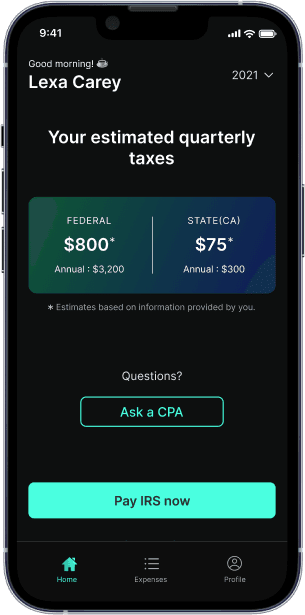
Quarterly tax deadline is Jan 15. See how much you owe penalties
1099 Tax Calculator

Are you self-employed?
This includes freelancers and business owners.
What is the Tax Rate for 1099 Income 2023?
Your employer normally manages payroll taxes, including Social Security and Medicare contributions, when you work as an employee. But, since you work for yourself, you are in charge of paying these taxes. In 2023, the self-employment tax rate is 15.3%, which encompasses both Medicare and Social Security taxes. The Social Security tax is 12.4% of your net self-employment income. The Medicare tax is 2.9% of your net self-employment income. It's crucial to remember that the first $160,200 of your taxable self-employment income is the sole amount subject to the 15.3% tax rate. Medicare tax is applied at a rate of 2.9% on any amount over this threshold. If your income surpasses $200,000, an extra 0.9% Medicare tax is imposed. If you're self-employed, you might wonder,do I have to pay Social Security taxes?
Table of contents
Understanding Self-Employment Tax
Self-employment tax is a crucial aspect of being self-employed, whether you’re a freelancer, independent contractor, or small business owner. Unlike traditional employees, self-employed individuals are responsible for paying their own Social Security and Medicare taxes. The self-employment tax rate is 15.3%, which includes 12.4% for Social Security and 2.9% for Medicare. This tax is applied to your net earnings from self-employment, ensuring that you contribute to these essential social programs just like any other worker.
How is Self-Employment Tax Calculated?
Calculating self-employment tax involves determining your net earnings from self-employment activities such as freelance work, consulting, or running a small business. The self-employment tax rate of 15.3% is applied to 92.35% of your net earnings. For example, if your net earnings are $100,000, you would calculate 92.35% of that amount, which is $92,350. Then, you apply the 15.3% tax rate to this figure, resulting in a self-employment tax of $14,126.55. Using a self-employment tax calculator can help you estimate your tax liability and ensure you make accurate quarterly estimated tax payments.
How 1099 Income Is Affected by Federal Income Tax Brackets
The amount of your 1099 income that is subject to federal income taxes is determined by the federal income tax brackets. There are seven federal income tax rates in 2023, with rates ranging from 10% to 37%. The brackets relate to 1099 income as follows:
- 10% Tax Bracket:Single filers pay zero to $11,000, married couples filing jointly pay zero to $22,000.
- 12% Tax Bracket:Single filers pay $11,001 to $44,725 and married couples filing jointly pay $22,001 to $89,450.
- 22% Tax Bracket:Single filers pay $44,726 to $95,375, while married couples filing jointly pay $89,451 to $190,750.
- 24% Tax Bracket:$190,751 to $364,200 for married couples filing jointly, $95,376 to $182,100 for single taxpayers. The32% Tax Bracketranges from $182,101 to $231,250 for individuals filing alone and from $364,201 to $462,500 for couples filing jointly.
- 35% Tax Bracket:Married couples filing jointly will pay $462,501 to $693,750, while single filers will pay $231,251 to $578,125. Above $578,125 for solo taxpayers and above $693,750 for married couples filing jointly is the37% Tax Bracket.
What is the Independent Contractor and Freelancer Marginal Tax Rate
The highest tax rate you pay on your final dollar of income is known as the marginal tax rate. Your marginal tax rate is 22%, for instance, if you make $50,000 and are in the 22% tax band. However, credits and deductions may cause your effective tax rate to be lower. Understanding your marginal tax rate helps you know how much you need to pay taxes on your 1099 income. This is how it operates:
- Instance:If your taxable income is $50,000, you will pay the following: 10% on the first $10,275; 12% on the next $31,500; and 22% on the remaining $8,225.
Your effective tax rate in this scenario would be less than your marginal tax rate, at about 11%.
Variations in Tax Rates from Prior Years
Every year, tax rates and brackets are subject to change. The tax brackets have been updated to account for inflation for 2023. Here's how it compares to prior years: Comparing 2022 and 2023: Deductions for standard deductions have gone up. The standard deduction for individuals filing alone increased from $12,950 in 2022 to $13,850 in 2023. It increased from $25,900 in 2022 to $27,700 in 2023 for married couples filing jointly.
Tax Treatment Disparities between 1099 and W-2
The way income is reported and taxed is the primary distinction between the 1099 and W-2 tax treatment. Form 1099-MISC or 1099-NEC should be used to report 1099 income. To understand more about the differences in paying1099 tax and W-2 tax, you can explore further resources. 1099 contractors are responsible for paying taxes on their income, including self-employment taxes.
1099 Income
W-2 Income
Techniques to Lower 1099 Tax Obligation by Using Credits and Deductions
You can lower your tax obligation as a self-employed person by utilizing a number of credits and deductions. Discover thetop ways to save taxes using write-offsto optimize your savings.
- Home Office Deduction:You may be able to write off costs such as mortgage interest, insurance, utilities, repairs, and depreciation if you use a specific area for your business.
- Health Insurance Deduction:You can deduct premiums from your taxes if you don't have access to coverage through an employer-sponsored plan.
- Self-Employment Tax Deduction:Depending on your adjusted gross income, you could be entitled to deduct the employer-equivalent amount of your self-employment tax.
- Retirement Deduction:You can lower your taxable income by contributing to eligible plans, up to a specified amount.
- Firm Expenses:Maintain a record of all costs incurred for your firm, including supplies, equipment, travel expenses, and expert fees. These can lower your taxable income considerably.
- Estimated Quarterly Tax Payments:You are required to submit anticipated tax payments every quarter if you anticipate owing $1,000 or more in taxes for the year. By doing this, you can avoid incurring fines for underpayment.
You may control your taxes and lower your burden by being aware of these tactics and how the federal income tax brackets relate to 1099 revenue. To optimize your savings, keep close tabs on all of your outlays and deductions.
Quarterly Estimated Tax Payments
What are Quarterly Estimated Tax Payments?
Quarterly estimated tax payments are essential for self-employed individuals who expect to owe more than $1,000 in taxes for the year. These payments help you stay on top of your tax liability and avoid penalties for underpayment. The IRS requires these payments to be made on a quarterly basis, with due dates on April 15th, June 15th, September 15th, and January 15th of the following year. By making these payments, you can manage your tax obligations more effectively throughout the year.
How to Make Quarterly Estimated Tax Payments
Reporting Self-Employment Income
When it comes to reporting your self-employment income, you’ll need to use Schedule C (Form 1040). This form requires you to detail your business income and expenses, allowing you to calculate your net profit or loss from self-employment. The net profit or loss is then reported on your tax return and is subject to both income tax and self-employment tax. Accurately reporting your business activities ensures you pay the correct amount of taxes and helps you avoid potential issues with the IRS.
Final Thoughts
As a self-employed person, navigating the tax system can be intimidating, but with the correct help, it becomes more doable. You may make sure you're paying your taxes and easing your financial load by being aware of the self-employment tax rate, federal income tax brackets, and methods to lower your tax bill. Always keep a record of your earnings and outlays, and get advice from a tax expert when necessary. You can remain on top of your taxes and steer clear of any potential traps by doing this. For those who need tofile taxes with both W-2 and 1099, understanding the differences and requirements is crucial.
What’s FlyFin?


Expert tax CPAs ensure 100%-accurate tax filing

A.I. finds every tax deduction, eliminating 95% of your work

On average users save $3,700